

We Put a Mirror in Every Meeting
Why self-view distracts us—and how video conferencing could preserve confidence without demanding our attention.

My eight-year-old daughter came home from school early with a sore throat, so I scheduled a virtual urgent-care appointment.
Before the call, we prepared together. I asked her to be present. I asked her to answer the doctor’s questions. I asked her to listen carefully to what the doctor said.
She did great.
I did most of the talking because I am her father and she is eight, but she sat beside me, looked at the computer, and appeared completely engaged. The appointment went smoothly. The doctor answered our questions, explained what to watch for, and told us what to do next.
When the call ended, I looked at my daughter.
“What did you learn?”
“Ummm,” she said. “I don’t know.”
I pressed her. Then I pressed her again. Something must have distracted her if she could not remember what the doctor had said.
Eventually, she pointed to the bottom of the screen.
“That little picture of me.”
And I understood immediately.
Because that little picture distracts me too.
It distracts me during business meetings. It distracts me during interviews. It distracts me when I am trying to listen carefully to someone I care about. I find myself checking my hair, my expression, my posture, the light behind me, and whatever may or may not be happening over my shoulder.
Sometimes I am not even evaluating anything in particular. I am simply looking because the image is there.
We have placed one of humanity’s oldest technologies inside one of its most important modern communication systems.
The fucking mirror.
An all-day reflection is not a normal conversation
In an ordinary face-to-face conversation, we watch the other person. We read their expression, posture, attention, and emotion. We notice when they are confused, amused, concerned, or ready to speak.
What we generally do not do is hold up a mirror beside their face and study ourselves at the same time.
Video conferencing made that strange arrangement routine. The people in front of us became a collection of rectangles, and we became one of the rectangles. The interface asks us to participate in a conversation while simultaneously observing our performance from a few inches away.
The result is not quite a meeting. It is a meeting conducted in front of a mirror.
Before COVID-19, many people used video conferencing occasionally. Today it extends far beyond office work. We use it for school, medical care, therapy, job interviews, legal consultations, family conversations, and countless other interactions in which attention and trust matter.
The interface changed the environment around human communication. We adapted to it so quickly that we rarely stop to ask what the interface may be doing to the conversation itself.
Researchers have begun asking that question. Work from Stanford’s Virtual Human Interaction Lab identifies mirror anxiety—negative self-focused attention associated with seeing one’s own image—as one contributor to videoconference fatigue. In a study of 9,787 participants, people reported greater fatigue when video meetings produced mirror anxiety, a sense of being watched, physical confinement, and additional effort around nonverbal communication.
Another study found that facial-appearance dissatisfaction helped explain differences in reported videoconference fatigue and suggested that reducing self-focused attention may improve the experience. A small 2024 EEG experiment also found greater physiological indicators of fatigue when self-view was on, although its limited sample and mixed findings are reasons to avoid declaring the question settled.
That is an important distinction. My daughter’s experience is an observation, not proof that self-view causes children to learn less. The existing research does not give us license to make that claim.
It gives us a reason to investigate.
We keep looking for a reason
It is tempting to explain this behavior as vanity.
Humans are vain. We worry about our hair, our skin, our posture, our teeth, and the possibility that something improbable has gone terribly wrong with our face in the last thirty seconds.
But “vanity” is too dismissive. Self-view also provides useful information.
Is my face still in the frame? Is the room too dark? Is the camera frozen? Did the virtual background stop working? Did one of my children enter the room? Is there food in my teeth? Am I making a strange expression without realizing it? Did I accidentally leave the laundry visible behind me?
The probability of any one problem may be low. The social cost of missing it can feel high.
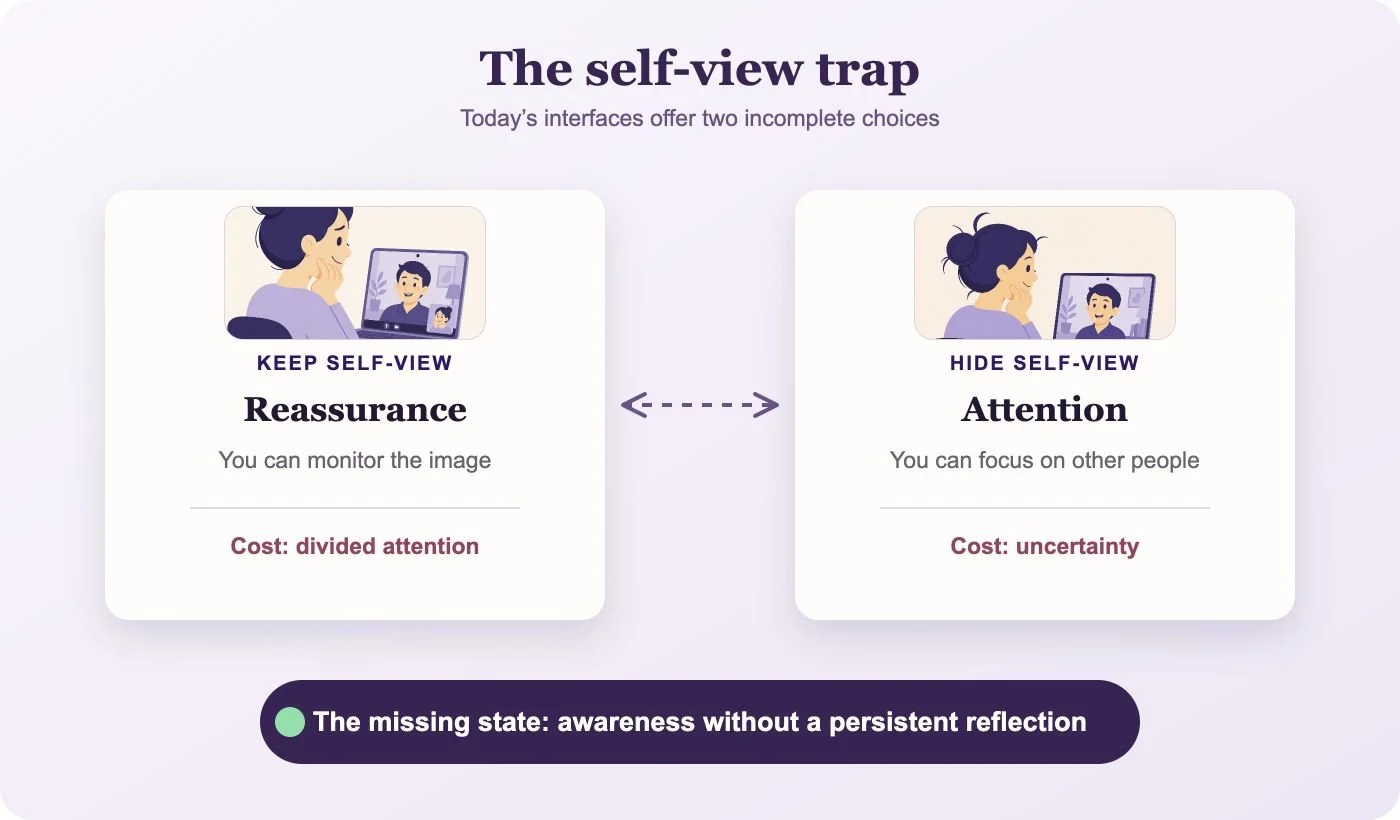
That creates an asymmetric risk. If the other person can monitor how they appear and I cannot, I may feel that I have placed myself at a disadvantage. So I leave the mirror visible. The reassurance is real, even when the monitoring is unnecessary.
Current meeting platforms recognize at least half of the problem. Zoom and Microsoft Teams allow people to hide their self-view while keeping their camera visible to everyone else. Zoom’s own support documentation notes that seeing one’s video can be distracting. Teams similarly offers a “Hide me” control that affects only the local display.
Those controls are useful. They are also incomplete.
They force us to choose between two imperfect states:
- Keep the mirror. Preserve awareness, but sacrifice some attention.
- Hide the mirror. Protect attention, but lose reassurance.
The better question is not, “How do we hide self-view?”
It is, “What job was self-view performing—and can we perform that job without displaying a continuous reflection?”
The proposed system
Replace the mirror with a signal
The camera already sees the image. There is no reason the human should have to inspect it continuously.
PRESENCE / 01 is built around one principle:
Continuous video for other people. Exception-based awareness for yourself.
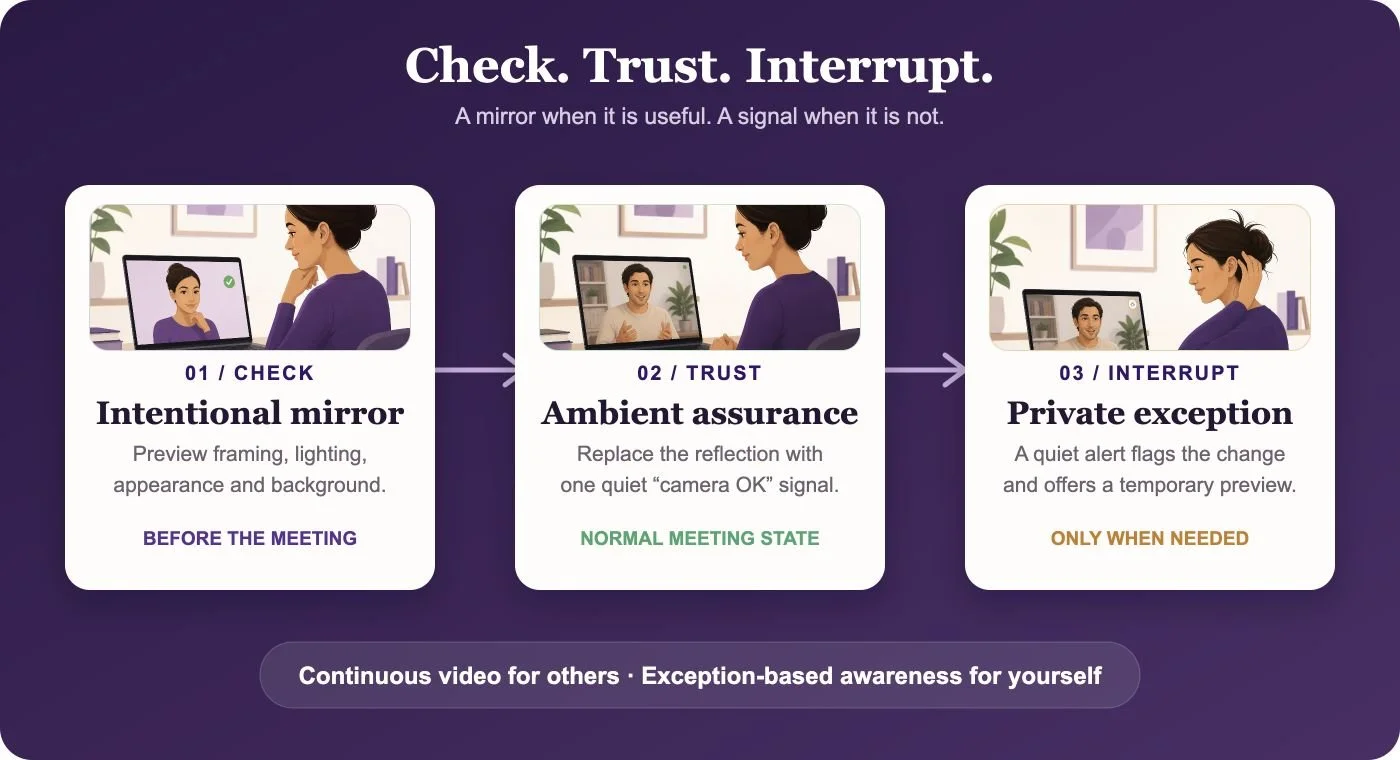
01 · Check
Before joining, the user sees a normal preview. They check framing, lighting, appearance, and background intentionally. When they are ready, the image becomes the meeting’s visual baseline.
02 · Trust
The live reflection disappears. In its place is a quiet status indicator: ● Camera looks normal. Nothing demands attention because nothing requires attention.
03 · Interrupt
If a meaningful condition changes, the system presents a specific private signal:
- Face partly outside frame
- Lighting changed
- Camera may be obstructed
- Unexpected background movement
- Virtual background may be failing
- Something new is covering part of your face
The user can press and hold the signal to reveal a three-second preview. When the issue is resolved, the mirror disappears again.
What the interface could look like
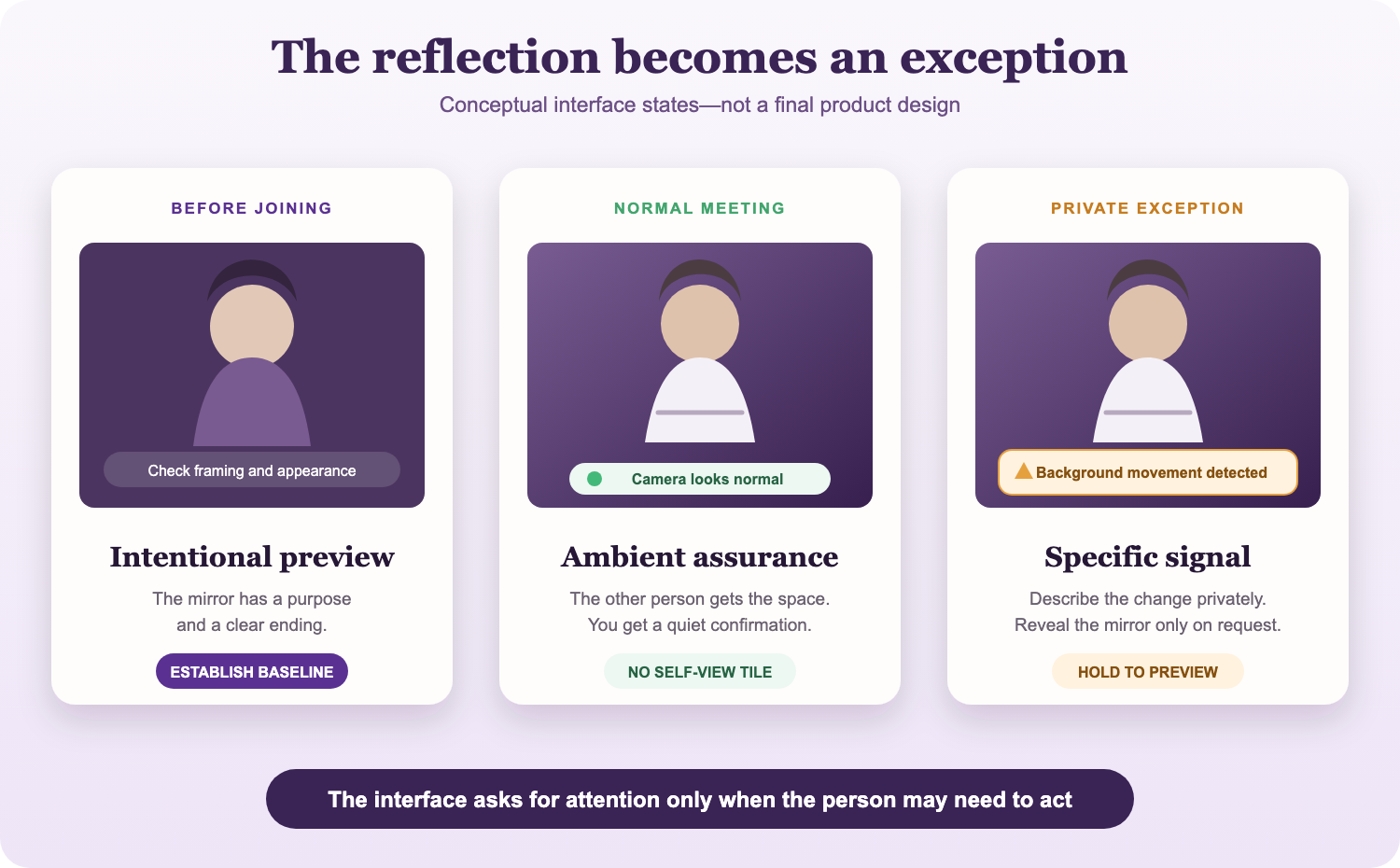
The most important feature of PRESENCE / 01 is what is missing: the persistent self-view tile.
During the normal state, the speaker or shared content receives the space and visual priority. A compact assurance chip remains available at the edge of the interface. It confirms that the camera is working without displaying the feed.
When an exception occurs, the chip changes color and states the condition. The alert remains private; other participants do not see it. A temporary preview is always available, but it never becomes the permanent default.
This is not an appearance filter. It is not an avatar. It does not replace the person, smooth the person, or generate a more flattering interpretation of the person.
It is an attention product.
The purpose is not to improve the image. The purpose is to return the user’s attention to everyone else.
Trust would have to be designed, not promised
A feature that monitors someone’s camera feed can easily become more invasive than the mirror it replaces. PRESENCE / 01 would only be credible if privacy and user agency were part of the architecture from the beginning.
- On-device processing. Monitoring should not require transmitting or storing additional image data.
- No identity recognition. The system does not need to know who the user is.
- No emotion inference. It should never declare that someone looks angry, sad, disengaged, or deceptive.
- No attractiveness or professionalism scoring. Those judgments are subjective, culturally loaded, and vulnerable to bias.
- User-selected signals. People should decide which conditions matter to them.
- Accessible alternatives. Signals should be available visually, audibly, or through haptics without becoming another distraction.
- A visible off switch. The user must remain in control of the feature and the camera.
Some proposed signals are technically straightforward. Detecting whether a face has moved out of frame, whether lighting changed, or whether the lens is obstructed is already within the general capability of modern computer vision.
Other examples—such as identifying food in someone’s teeth or deciding whether something about their appearance is genuinely anomalous—are much harder. They could create false alarms, embed cultural assumptions, or generate exactly the kind of self-consciousness the product is intended to reduce.
Those should be treated as research questions, not feature promises.
The generation growing up inside the mirror
Adults remember a world before every conversation contained a self-view tile.
Children increasingly do not.
Generation Alpha is growing up using video for school, tutoring, medical appointments, therapy, games, and family relationships. For them, watching themselves while interacting with another person may feel ordinary.
Ordinary does not mean neutral.
We should study whether persistent self-view affects attention, recall, anxiety, participation, and self-consciousness in children—and whether those effects differ by age, neurodiversity, culture, or context. A design appropriate for an adult sales meeting may not be appropriate for a pediatric appointment or a virtual classroom.
The story of my daughter does not answer those questions.
It makes them harder to ignore.
A simple experiment
You do not need new software to test the central premise. For your next several video meetings:
- Use the normal self-view for the first minute.
- Confirm that your framing, lighting, and background look acceptable.
- Hide your self-view while leaving your camera on.
- At the end, write down what you remember and how often you worried about your appearance.
- Compare that experience with meetings in which the mirror remained visible.
This will not produce rigorous scientific evidence. It may reveal how often your attention has been divided without your noticing. If the hidden view makes you anxious, that matters too. It is evidence that simply removing the mirror does not finish the design job.
Technology should carry the cognitive load it creates
The mirror is not evil.
The mistake was turning it from a tool we consult intentionally into an environment we inhabit continuously.
Video conferencing restored essential parts of human communication to remote interactions. It lets us see the people we are speaking with, perceive emotional reactions, and feel present across distance. Those are extraordinary benefits.
But the interface also introduced a new participant into every conversation: our own reflection.
We accepted it because cameras needed a preview and because no one wanted to look unprepared. We kept it because awareness feels safer than uncertainty. We learned to tolerate the distraction because the alternative seemed to be surrendering control.
That is no longer the only choice.
The camera can monitor the image.
The human can attend the meeting.
We do not need a better mirror.
We need a way to stop needing one.
About the project
PRESENCE / 01 is a speculative human-computer interaction concept from the Revenue Dimensions 01 Lab, an ongoing series by Ben Coffee exploring overlooked problems at the intersection of people, systems, and emerging technology.
The concept is intended to provoke research and product discussion. It is not affiliated with Zoom, Microsoft, Google, or any videoconferencing provider.
Sources and further reading
- Fauville et al. (2023), Video-conferencing usage dynamics and nonverbal mechanisms exacerbate Zoom fatigue.
- Ratan, Miller, and Bailenson (2022), Facial appearance dissatisfaction explains differences in Zoom fatigue.
- Xu et al. (2024), Does self-view mode generate more videoconferencing fatigue in women than men?
- Zoom Support: Adjusting your video layout.
- Microsoft Support: Use video in Microsoft Teams.