

All Vacuum Cleaners Suck. And in a Bad Way.
A serious inquiry into why suction is not the same as cleaning—and an unreasonable machine built to make the difference impossible to ignore.
This began with hair
I live in a house with three girls and a dog. There is always hair somewhere.
It collects along baseboards. It gathers beneath furniture. It finds the narrow seam where the floor meets the wall and settles there with the confidence of something that understands the limits of household technology.
I am responsible for vacuuming, which means this is not an occasional observation. It is a recurring relationship between me, a surface, and a machine that appears to have arrived prepared for the assignment.
The vacuum turns on. The motor spins. The noise suggests industrial resolve. The loose material in the center of the floor disappears.
Then I reach the edge.
I move the machine forward. I move it backward. I approach from another angle. I watch the same hair remain exactly where it was, lightly attached to the surface and apparently protected by a treaty the vacuum has agreed to honor.
Eventually, I bend down and pick it up by hand.
This is not a catastrophe. It is something more interesting: a small, repeated disappointment that an entire product category has taught us to accept.
The technology works. The experience does not.
You know why I like an iPhone?
Because nearly every time I use it, it just works.
You know why I dislike vacuum cleaners?
Because nearly every time I use one, I am routinely disappointed.
It is usually not because the motor failed. The machine created suction. Air moved through the intake. Loose material entered the nozzle. The vacuum performed the mechanism it was designed to perform.
The surface was still dirty.
That distinction matters. A product can function correctly while failing to create the outcome a person expected. In business, technology, and product design, this is a common source of hidden friction. The system reports success because its components operated as specified. The customer reports disappointment because the job remains unfinished.
Both assessments can be true.
Vacuum cleaners are an unusually visible example of a broader problem: categories tend to optimize the mechanism they inherited rather than reconsider the outcome people actually need.
A vacuum removes. A towel cleans.
Suction is useful. CONTACT / 01 does not propose eliminating it.
A vacuum is excellent at capturing loose debris: crumbs, dust, hair, grit, and whatever the dog carried inside without filing the appropriate paperwork. But surfaces are not dirty only because loose objects are resting on them.
Fine residue can cling through moisture or static. Oil creates films. Dried spills adhere. Particles settle into seams and textured surfaces. These forms of dirt need something suction alone cannot reliably provide: physical contact.
They need pressure. They need shear. They need absorbency. They need to be loosened from the surface before they can be carried away.
That is why, when something is actually dirty, we reach for a towel.
What if towel contact loosened and wiped while suction captured and removed?
That is the defensible half of CONTACT / 01. The remainder required a more flexible relationship with judgment.
The machine stops before the room does
Every conventional cleaning head has a protected envelope. The moving components remain behind a housing or inside a nozzle. This is sensible. Guards keep rotating parts away from fingers, hair, cords, curtains, pets, and the entire category of objects known as “things you did not intend to clean.”
The protection also creates a boundary.
The housing reaches the wall before the useful mechanism does. The vacuum can approach a baseboard, backsplash, or corner, but the part capable of agitation remains safely inside the machine. A narrow untouched strip survives between the operating mechanism and the room.
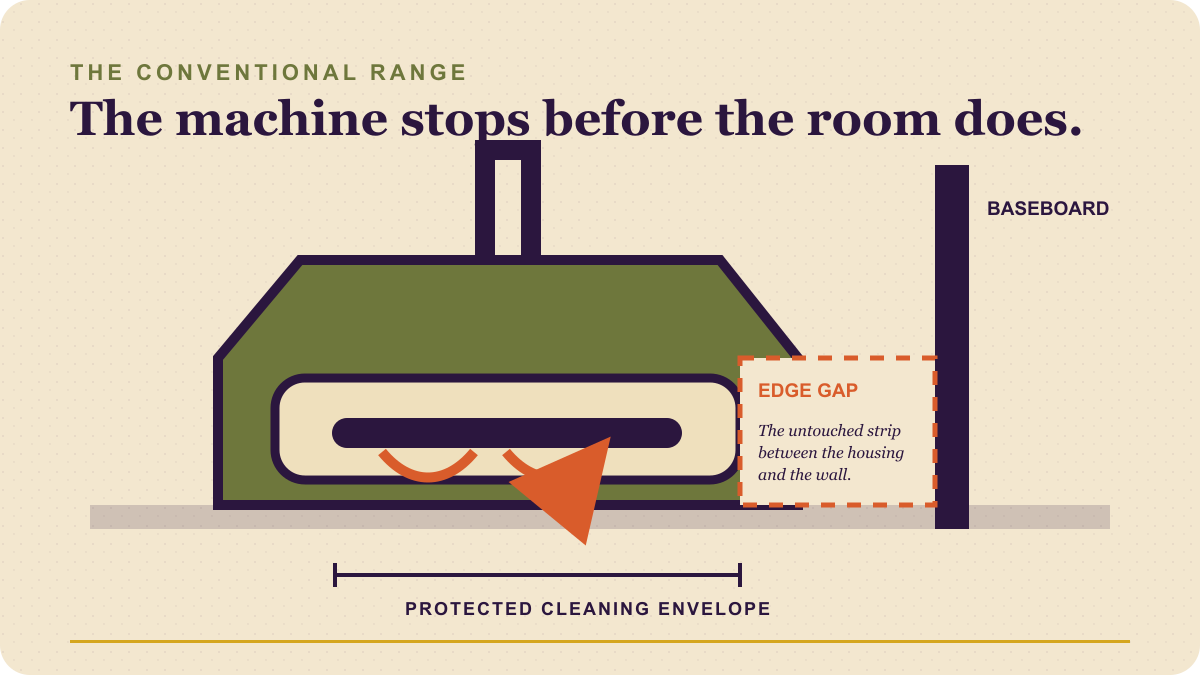
Manufacturers call this edge performance.
I call it stopping early.
Once the problem is framed that way, a different question becomes possible: what if the cleaning surface extended beyond the machine?
Contact plus capture
CONTACT / 01 combines two familiar systems: a compact vacuum motor and intake to capture loose debris, and a rotating contact assembly inspired by an automatic car wash to loosen, wipe, and absorb what suction leaves attached.
The project initially explored a larger floor machine with an extended contact field. Towels reached beyond the body on the left, right, and front so the active cleaning area could touch the surfaces a rigid housing could not.
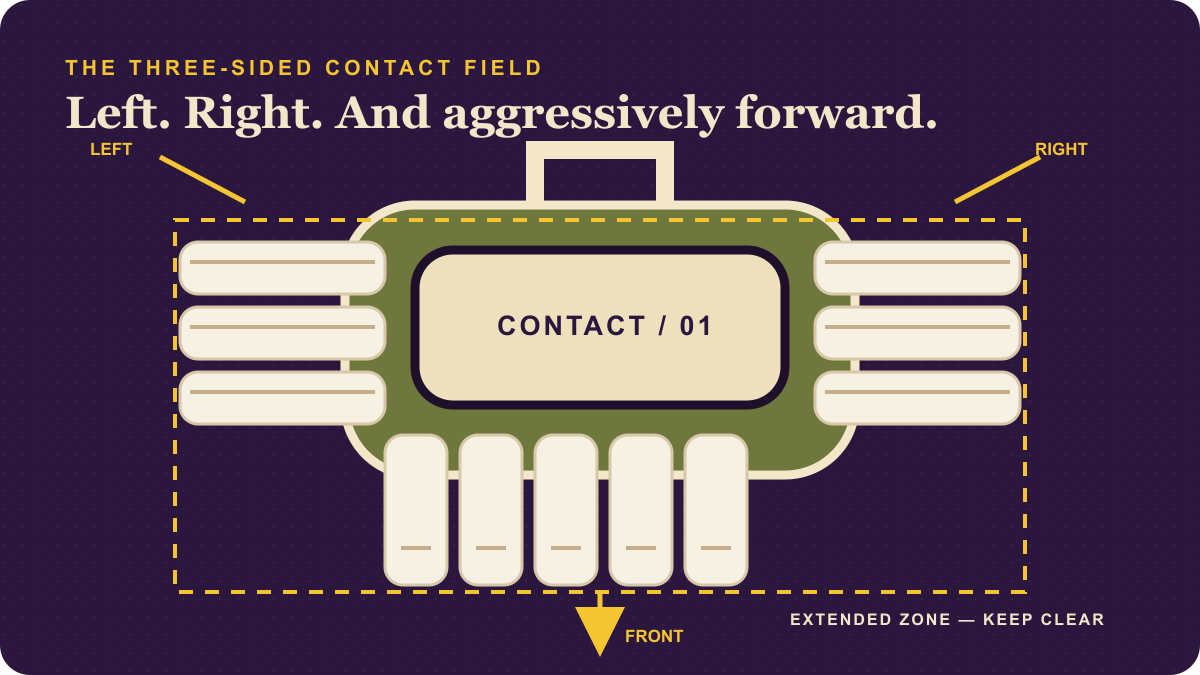
The principle was right, but the machine was too large and the towels looked as though some of them had arrived independently. A coherent mechanism matters, even when the concept itself is ridiculous. Every moving element needs a visible origin, a comprehensible path, and a surface it is attempting to clean.
The idea became more convincing when it became smaller.
Introducing CONTACT / 01 Handheld
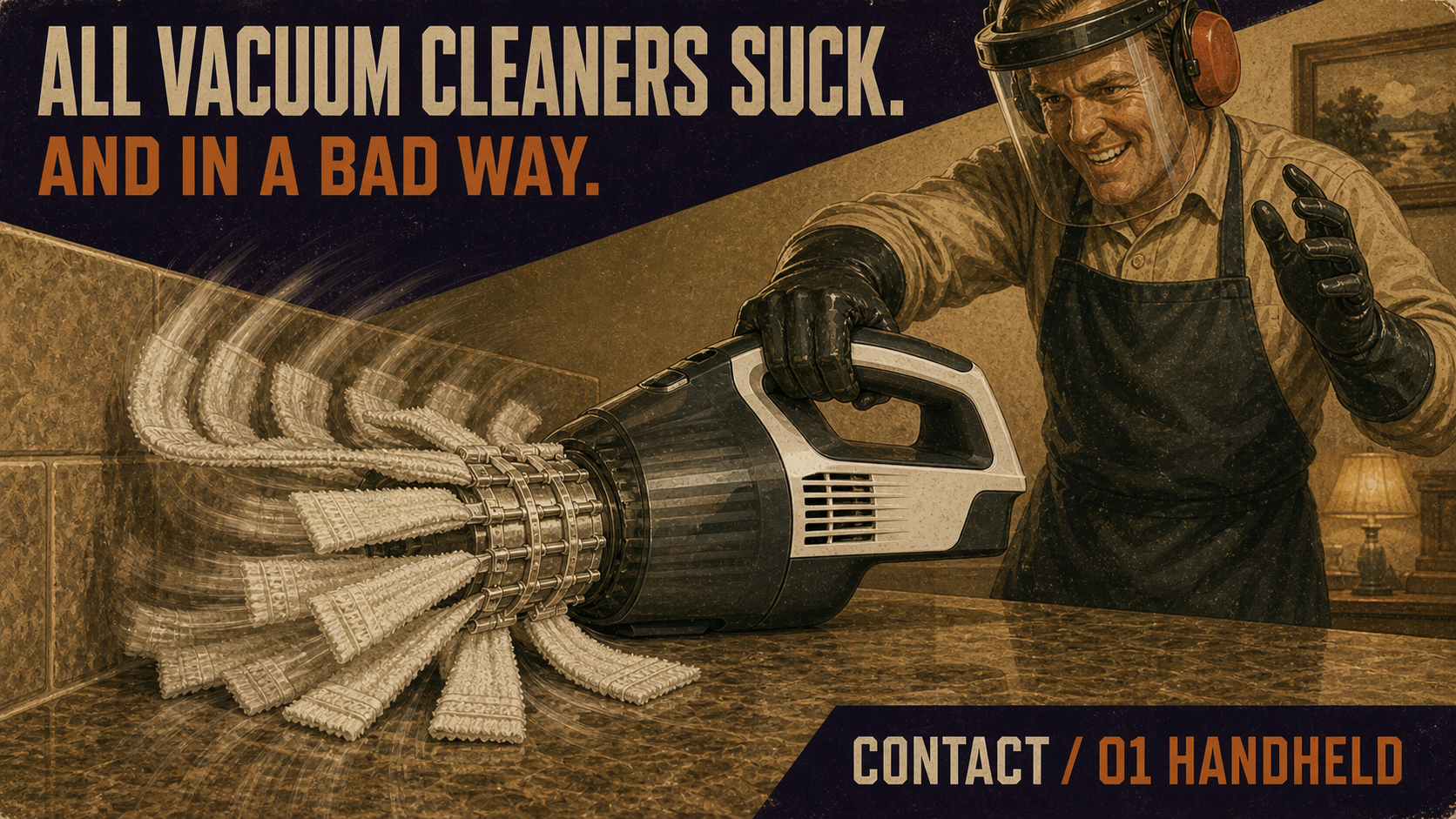
The handheld version begins with familiar proportions: a compact body, integrated top handle, intake, motor, and one-handed control.
Then the front-left safety shroud disappears.
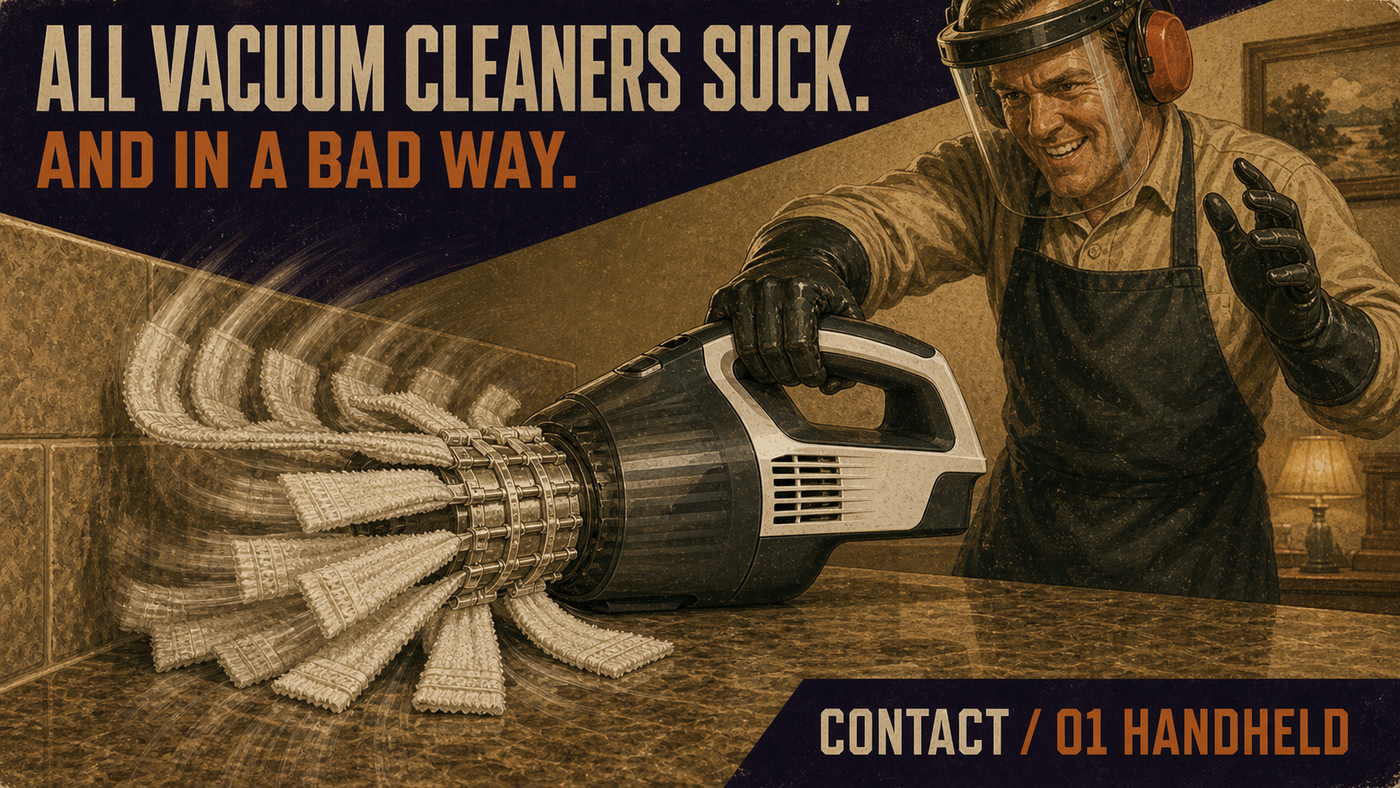
Projecting from that opening is a horizontal, car-wash-style rotor. Around it are miniature white Turkish shower towels, each visibly clamped at its inner end.
The upper towels strike the backsplash. The lower towels compress against the countertop. The middle towels fold into the seam. Behind them, suction captures loose debris and dislodged material.
The machine is small enough to operate with one hand. The contact zone has other ambitions.
Why Turkish towels?
Are Turkish shower towels the ideal material for a compact, high-speed cleaning rotor?
Almost certainly not.
Are they visually superior to anonymous industrial strips?
Completely.
The idea becomes clearer when the cleaning elements remain recognizable. These are proper little towels: plush terry pile, finished edges, and decorative woven bands. Each carries the faint suggestion that it should be hanging peacefully beside a bath.
Instead, it has been individually clamped to an exposed power tool.
The contrast is funny, but it also performs useful explanatory work. You can see what each element is meant to do. The towels communicate wiping and absorption immediately. Their softness contrasts with the machine’s industrial aggression. The absurdity makes the mechanism legible.
The breakthrough is the missing guard
Car washes already use rotating cloth strips to create repeated surface contact. Handheld vacuums already provide compact motors, suction, and convenient handles.
CONTACT / 01 contributes the kind of insight that becomes possible when two proven ideas are combined without inviting either safety team to the meeting.
The dangerous side is not accidental. It is the left side—the place where a normal nozzle or protective barrier should be.
Removing the guard allows the towels to extend beyond the appliance’s footprint. They begin cleaning before the body arrives. They reach the countertop, backsplash, and inside corner simultaneously. They continue where a rigid housing cannot.
Other manufacturers prevent the cleaning mechanism from touching anything outside the machine. CONTACT / 01 considers that a design flaw.
This is the breakthrough. It is also the warning label.
Extremely important qualification
Is it dangerous?
Incredibly.
An exposed high-speed fabric rotor would introduce obvious entanglement, impact, ejection, spray, contamination, and control hazards. The operator is wearing a face shield, hearing protection, heavy gloves, long sleeves, and an apron because the concept only works if everyone acknowledges that the appliance has arrived with terms and conditions.
The obvious question is whether we could reinstall the safety shroud. Of course we could.
Then who is going to clean the corner?
This is satire, not safety guidance. CONTACT / 01 should not be built or operated. Its job is to make the tradeoff visible enough that we can think about it.
Constraints contain information
It would be easy to conclude that this project is about removing constraints. It is not.
Constraints often exist for excellent reasons. The guard protects the user. The housing controls debris. The enclosed mechanism makes a domestic appliance physically compatible with a home.
But constraints also shape what a system can accomplish. When a product repeatedly fails near a boundary, it is worth identifying whether the boundary is fundamental, inherited, or simply unexamined.
The useful exercise is not to discard the constraint. It is to understand what the constraint costs, then ask whether another architecture could preserve the protection while improving the outcome.
Could the contact elements extend only when pressed against a surface? Could a compliant shroud move with the wall? Could a slower oscillating textile reach the corner without creating an entanglement device? Could contact and capture be separated into coordinated stages?
The ridiculous prototype does not answer those questions. It earns the right to ask them.
What this project is actually about
I work on systems for a living. Usually they involve growth, technology, data, teams, customers, and the decisions organizations make when the obvious answer is not producing the required result.
Sometimes that habit produces a marketing operating model. Sometimes it produces a handheld vacuum with the safety nozzle removed and a car-wash rotor full of miniature Turkish towels bolted to the front.
- Begin with the outcome. What is the person actually trying to accomplish?
- Separate activity from success. Which components are working even though the experience remains disappointing?
- Identify the inherited mechanism. What does the category keep optimizing because it has always optimized it?
- Look for the unfinished work. What remains attached, untouched, confusing, or unresolved?
- Find the accepted boundary. Which limitation has become so familiar that people no longer describe it as one?
- Make the alternative visible. Build a coherent enough model that people can react to the idea.
- Push until the tradeoff appears. Exaggeration can expose both the opportunity and the reason it has not been pursued.
- Recover the useful principle. Keep the insight, restore judgment, and put the safety equipment back where it belongs.
A ridiculous machine can still reveal a serious idea
There is a temptation to dismiss unconventional ideas at the moment they become impractical. That is often too early.
An impractical concept can contain a valid diagnosis. It can reveal that the category is measuring the mechanism rather than the outcome. It can show where a system stops. It can give form to a frustration people recognize but have not articulated.
CONTACT / 01 is not ready for your home. It is not ready for a laboratory. It is not ready for the Consumer Product Safety Commission.
But it has already clarified something I could feel every time I vacuumed along a wall:
Suction is not the same as cleaning.
The better system may not require more power. It may require a complementary interaction—contact to loosen and wipe, capture to remove.
The exposed Turkish-towel rotor is unlikely to be that system. It is simply unwilling to let us ignore the question.
All vacuum cleaners suck.
And in a bad way.